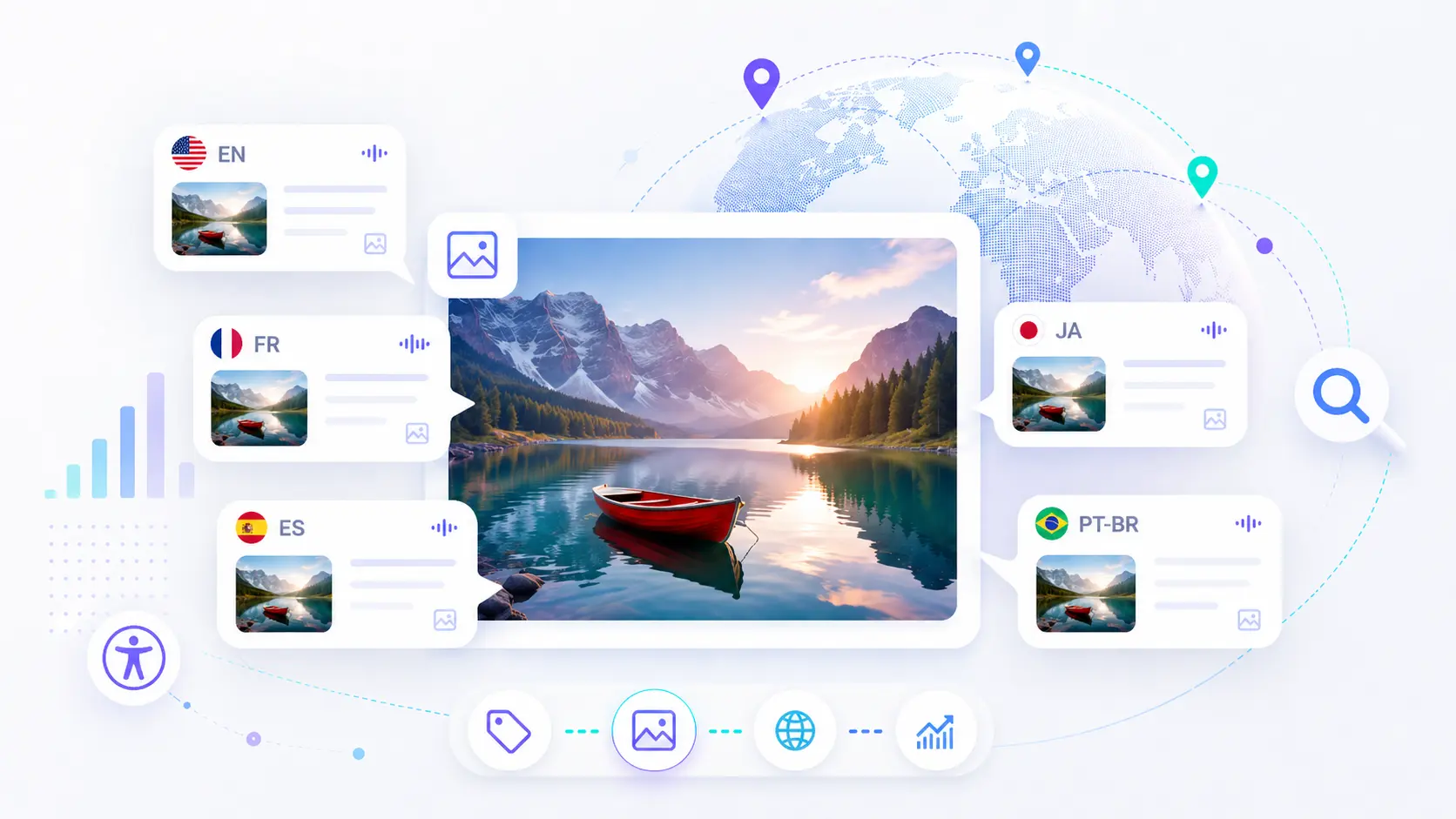
If your site sells, publishes, or supports users in more than one language, your images need alt text in more than one language too. The same product photo that reads as "hand-thrown ceramic mug in matte sage green" for an English shopper has to read just as cleanly as « mug en céramique tournée à la main, vert sauge mat » for a French one. Alt text matters both for screen reader users and for the local Google index that decides whether your image shows up at all.
Multilingual alt text is one of the highest-leverage, lowest-effort moves in international SEO. Most teams translate body copy, product titles, and meta descriptions, then ship the same English alt text to every locale, sometimes with no alt text at all. This guide walks through the why, the how, and the regional variants almost everyone overlooks, with side-by-side translation examples drawn from our own examples library.
Summary
Multilingual alt text is alt text written in each language your site supports, not left in English on a French or Japanese page and not machine-translated as an afterthought from a sloppy English source. Search engines associate alt text with the page's declared language, so an English alt attribute on a Spanish page sends a confused signal to Google's local index, AI Overviews, and the screen reader pronouncing it. The biggest wins come from matching alt text to the lang attribute on each page, preserving brand and proper nouns across languages, and honoring regional variants (Brazilian vs. European Portuguese, Simplified vs. Traditional Chinese, French vs. French Canadian) that most translation workflows flatten.
Why multilingual alt text matters for international SEO
International SEO is the practice of structuring your site so each language and country version ranks in the search engine that serves that market: Google.fr for France, Google.de for Germany, Yandex for Russia, Naver for South Korea, Baidu for mainland China. Each of those engines indexes your images separately, and each scores them against queries written in the local language. Alt text in the wrong language is a wasted signal in every one of them.
- Local image search. Google Images is the second-largest search property after Google Web Search, and a significant share of those queries are not in English. Your alt text is the primary text signal that ties an image to a query.
- AI Overviews and multimodal search. Google's AI Overviews, ChatGPT search, and Perplexity all read alt text alongside the image to decide whether to cite a page. We covered this in our guide to Generative Engine Optimization. When these engines answer in French or German, they cite pages with French or German alt text.
- Accessibility for non-English speakers. Screen readers respect the page's
langattribute when pronouncing alt text. English alt text on a Spanish page is read in an English voice with English phonetics, which is confusing for a Spanish-speaking blind user and a clear WCAG 3.1.2 (Language of Parts) failure. - Legal compliance. The European Accessibility Act applies in 24 official EU languages. Missing or English-only alt text on a localized page is the most-cited WCAG 1.1.1 failure and a frequent target in ADA web accessibility lawsuits.
- Conversion in local markets. For ecommerce stores selling internationally, image search is a major shopping discovery surface. A Polish shopper searching "buty trekkingowe wodoodporne" will not find a product whose alt text reads "waterproof hiking boots".
How search engines associate language with images
Crawlers do not look at an image and guess what language it belongs to. They infer it from the signals around it. The four signals that matter most for image-language association:
- The page's
html langattribute. The strongest declarative signal. If it sayslang="es", every alt attribute on that page is interpreted as Spanish, including the ones you forgot to translate. hreflangannotations. Tell Google which page is the canonical version for which language and region. We discuss the structural side of this in Image SEO Best Practices.- The alt text itself, plus surrounding body copy. Search engines run language detection on the textual content. Mismatched alt text dilutes the page's language signal: the page looks like it is half English, half Spanish.
- URL and folder structure. A path like
/fr/produits/...or a country-code subdomain likefr.example.comis a softer but still useful hint.
When all four agree, the local index treats your image as canonical for that language and surfaces it for local queries. When they disagree, the signal degrades. Sometimes that gets bad enough that Google Images simply prefers a competitor's cleanly localized image instead.
The lang attribute, hreflang, and language signaling
The most common mistake we see is sites that translate the visible body copy, ship a Spanish page at /es/, and forget two things: the page-level lang attribute, and the alt attributes inside the page. Both have to update.
Set the page lang attribute correctly
<!-- English -->
<html lang="en">
<img src="/products/sage-mug.webp"
     alt="Hand-thrown ceramic mug in matte sage green, three-quarter view" />

<!-- French -->
<html lang="fr">
<img src="/products/sage-mug.webp"
     alt="Mug en céramique tournée à la main, vert sauge mat, vue de trois quarts" />

<!-- Japanese -->
<html lang="ja">
<img src="/products/sage-mug.webp"
     alt="手作りのセラミックマグカップ、マットなセージグリーン、斜め前から撮影" />
Use hreflang to link the localized versions
<link rel="alternate" hreflang="en" href="https://example.com/products/sage-mug" />
<link rel="alternate" hreflang="fr" href="https://example.com/fr/produits/mug-sauge" />
<link rel="alternate" hreflang="ja" href="https://example.com/ja/products/sage-mug" />
<link rel="alternate" hreflang="x-default" href="https://example.com/products/sage-mug" />
Use lang on individual elements when languages mix
If a single image needs alt text whose body is in one language but quotes a phrase in another, mark it with the lang attribute on a wrapper:
<html lang="en">
<figure>
  <img src="/menu/macarons.webp"
       alt="Tray of pastel macarons at Pâtisserie Lumière, Paris" />
  <figcaption>
    Pastry chef Marie Dubois prepares macarons at her shop, <span lang="fr">Pâtisserie Lumière</span>.
  </figcaption>
</figure>
This is WCAG 3.1.2 (Language of Parts) and helps screen readers switch pronunciation rules mid-sentence. For a deeper primer on alt text fundamentals, see What is Alt Text? The Complete Guide.
Translate or transcreate? Choosing the right approach
Three approaches exist for getting alt text into a second language. They sit on a quality-versus-scale spectrum:
| Approach | Best for | Tradeoff |
|---|---|---|
| AI-generated English plus machine translation | Producing accurate, consistent alt text across many languages at scale from a single image | Quality of the localized output follows the translation engine; brand and product names need explicit preservation markup to survive intact |
| Native LLM generation per language | Single-language sites where idiom and brand voice matter more than scaling to many locales | Slower and more expensive per image, and not every multimodal model handles every language equally well |
| Human transcreation | Marketing imagery, hero shots, content where idiom and brand voice are worth manual rework | Slowest and most expensive; impractical for thousands of product images |
For most teams shipping at scale, the first row is the realistic answer: a vision model writes an accurate English description of each image, and a translation engine produces every other language from that single source. Alt Text Studio runs exactly this pipeline. A leading multimodal model writes the English alt text from your image, with brand name, product name, and SEO keywords incorporated as context. Google Translate then produces output in any of 194 languages and regional variants, with brand and product strings flagged for verbatim preservation so they read identically across every locale.
Regional variants: the detail almost everyone misses
"Spanish" is not one language. "Portuguese" is not one language. "Chinese" is not even one script. Treating them as monolithic is the mistake that most often makes a localized site feel mostly translated to a native speaker. Close, but unmistakably off.
Alt Text Studio counts regional variants as distinct languages. They are listed separately in our 194-language total because that is how users select them and how the underlying models treat them. The most common pairs every international team should know:
| Variant pair | Why it matters |
|---|---|
Portuguese (Brazil) vs. Portuguese (Portugal): pt-BR vs. pt-PT | Different vocabulary (Brazilian "celular" vs. European "telemóvel" for "mobile phone"), different grammar choices, different orthography. A Brazilian shopper served European Portuguese alt text will notice within seconds. |
Chinese (Simplified) vs. Chinese (Traditional): zh-CN vs. zh-TW | Different writing systems entirely. Mainland China and Singapore use Simplified; Taiwan, Hong Kong, and Macau use Traditional. Serving the wrong one is unreadable, not just awkward. |
French (France) vs. French (Canadian): fr-FR vs. fr-CA | Vocabulary diverges meaningfully (Quebec "fin de semaine" vs. France "week-end"; Quebec "courriel" vs. France "email"), and Quebec also enforces French-language signage requirements that affect what counts as on-image text. |
| Spanish (Spain) vs. Spanish (Latin America) | Latin American Spanish drops the vosotros pronoun, uses different vocabulary for everyday items (Spain "ordenador" vs. Latin America "computadora"), and varies again between Mexico, Argentina, and Chile. |
| English (US) vs. English (UK) | Spelling alone (color/colour, jewelry/jewellery) and vocabulary (sneakers/trainers, pants/trousers) affect both ranking for local queries and how natural the alt text reads to local users. |
| Arabic regional variants | Modern Standard Arabic is the safe default for written content; Egyptian, Gulf, and Maghrebi Arabic differ enough in vocabulary that marketing copy can land flat. |
Pair the variant with the lang attribute
<html lang="pt-BR">, not just lang="pt". Pair it with hreflang="pt-BR" and pt-BR alt text. Search engines, screen readers, and browser spellcheck all use the regional tag to pick the right behavior. Examples: same image, multiple languages
Three images from our examples library, each shown with native alt text in five languages. Notice how the structure of the description stays consistent. What changes is the idiom, the word order, and how each language handles brand names and culturally specific objects.
Example 1: a clean landscape (no in-image text)

enA serene lake reflects snow-capped mountains and evergreen trees at sunrise, with mist hovering over the water. A small red boat is moored at the shore, enhancing the tranquil landscape.
esUn lago sereno refleja montañas nevadas y árboles perennes al amanecer, con neblina flotando sobre el agua. Una pequeña barca roja está amarrada en la orilla, realzando el paisaje tranquilo.
frUn lac paisible reflète des montagnes enneigées et des conifères au lever du soleil, avec une brume flottant au-dessus de l'eau. Un petit bateau rouge est amarré au rivage, soulignant la sérénité du paysage.
deEin ruhiger See spiegelt schneebedeckte Berge und immergrüne Bäume bei Sonnenaufgang wider, während Nebel über dem Wasser schwebt. Ein kleines rotes Boot liegt am Ufer vertäut und unterstreicht die friedliche Landschaft.
ja夜明けの静かな湖面に、雪をかぶった山々と常緑樹が映り込み、水面には霧が漂っている。岸辺には小さな赤いボートがつながれ、穏やかな風景を引き立てている。
pt-BRUm lago sereno reflete montanhas nevadas e árvores perenes ao amanhecer, com neblina pairando sobre a água. Um pequeno barco vermelho está atracado à margem, realçando a paisagem tranquila.
A clean landscape with no in-image text is the easiest case. The description structure is identical across languages, only the words change.
Example 2: a product with brand and product names

enA lit Amber Glow candle by Hearth & Pine sits on a textured stone table, surrounded by classic books, a small bust, and decorative stones, creating a cozy and elegant atmosphere.
esUna vela Amber Glow de Hearth & Pine encendida descansa sobre una mesa de piedra texturizada, rodeada de libros clásicos, un pequeño busto y piedras decorativas, creando un ambiente acogedor y elegante.
frUne bougie Amber Glow de Hearth & Pine allumée est posée sur une table en pierre texturée, entourée de livres anciens, d'un petit buste et de pierres décoratives, créant une atmosphère chaleureuse et élégante.
deEine brennende Amber Glow Kerze von Hearth & Pine steht auf einem strukturierten Steintisch, umgeben von klassischen Büchern, einer kleinen Büste und dekorativen Steinen, was eine gemütliche und elegante Atmosphäre schafft.
itUna candela Amber Glow di Hearth & Pine accesa è appoggiata su un tavolo in pietra strutturata, circondata da libri classici, un piccolo busto e pietre decorative, creando un'atmosfera accogliente ed elegante.
ja「Hearth & Pine」のAmber Glowキャンドルが灯され、質感のある石のテーブルの上に置かれている。周りにはクラシックな本、小さな胸像、装飾用の石が並び、居心地のよい上品な雰囲気を演出している。
Notice that Amber Glow and Hearth & Pine stay in their original form across every language. Translating brand and product names breaks searchability. A French shopper looking for "Amber Glow" will not find a candle described as "Lueur Ambrée".
Example 3: an image with cultural and locale-specific cues

enA child in a blue snowsuit and red hat joyfully builds a snowman in a snowy suburban neighborhood, with brick houses and holiday decorations in the background.
esUn niño con traje de nieve azul y gorro rojo construye con alegría un muñeco de nieve en un vecindario nevado, con casas de ladrillo y adornos navideños al fondo.
frUn enfant en combinaison de neige bleue et bonnet rouge construit avec joie un bonhomme de neige dans un quartier résidentiel enneigé, avec des maisons en briques et des décorations des fêtes en arrière-plan.
deEin Kind in einem blauen Schneeanzug und einer roten Mütze baut fröhlich einen Schneemann in einer verschneiten Vorstadtsiedlung, im Hintergrund Backsteinhäuser und festliche Dekorationen.
pt-BRUma criança com macacão de neve azul e gorro vermelho constrói alegremente um boneco de neve em um bairro suburbano coberto de neve, com casas de tijolos e decorações natalinas ao fundo.
pt-PTUma criança com fato de neve azul e gorro vermelho constrói alegremente um boneco de neve num bairro suburbano coberto de neve, com casas de tijolo e decorações festivas em segundo plano.
Watch the regional variants. Brazilian Portuguese uses "em um", "macacão", and "natalinas"; European Portuguese uses "num", "fato", and the more neutral "festivas". The same image, the same description, but two clearly distinct outputs, and the page lang attribute should match.
Generate this for your own images, in any of 194 languages
You just saw three images localized into five languages, with brand names preserved and regional variants honored. The same workflow scales to whatever your library looks like, from a handful of hero shots to thousands of product photos across every locale you ship to. Upload an image, pick your target languages, and Alt Text Studio handles the rest.
What to translate and what to keep
Not everything in your alt text should be translated. Some words carry meaning because they are in the original language, and translating them destroys searchability and brand recognition.
- Keep brand names. "Nike", "Apple", "Hearth & Pine", "Aeterna" are proper nouns and should appear identically in every language. A French shopper searches for "Nike", not "Aile-Victoire".
- Keep product names and SKUs. "Air Max 90", "MacBook Pro M4", "Velvet Bloom Eau de Parfum" are what your customer saw in advertising; that is what they will type into search.
- Keep place names with established local forms. Use München in German alt text, not Munich. Use 東京 or Tokio as appropriate. Most major cities have a recognized form in each language; use it.
- Keep on-image text accurately. If a sign in the photo says "Welcome Winter", say so in alt text. Do not paraphrase it as if it were translated. The text shown in the image is itself a fact about the image.
- Translate descriptive content. Colors, materials, settings, actions, and emotions are language-neutral facts that should read naturally in the target language.
- Translate units and measurements appropriately. Use metric in metric-using locales and imperial only where it is the local norm. A German alt text saying "12 ounce mug" is awkward; "350-ml-Tasse" is correct.
Cultural context and locale-specific cues
Some images carry cultural references that need deliberate handling, not literal translation:
- Holidays and seasonal imagery. "Holiday decorations" works in most contexts. "Christmas decorations" is specific and may not match every locale's framing of the same image. When in doubt, describe what is visually present (a wreath, a tree, lights) rather than naming the holiday.
- Currency, signage, and on-image text. If the image shows a "$" price tag, the alt text should reflect that. A German page describing the same image still says "Preisschild mit Dollarzeichen", not euros, because the image shows dollars.
- Body language and gestures. A thumbs-up means "good" in most Western markets and is offensive in parts of the Middle East. Describe what the gesture looks like, not what it means.
- Food and household items. A "casserole" in American English is roughly a "plat mijoté" in French, but the visual referent may be different. Describe the visible food, not the dish category.
- Reading direction. For RTL languages (Arabic, Hebrew, Persian, Urdu), make sure the rendered alt text is delivered in correctly encoded UTF-8 and that the page sets
dir="rtl". Yourimg altdoes not need a direction attribute itself, but the surrounding context does.
Common multilingual alt text mistakes
English alt text on every localized page
The most common mistake. The body translates; the alt attribute does not. Local Google indexes downrank or ignore the image, and the screen reader pronounces it in the wrong voice.
Forgetting the html lang attribute
Translating alt text but leaving the page declared as lang="en" tells search engines and screen readers the page is in English. The translated alt text confuses rather than helps.
Translating brand and product names
"iPhone" should always be "iPhone". Translating it kills brand searches in the local market.
Treating Spanish, Portuguese, or Chinese as monolithic
Shipping European Portuguese to Brazil, mainland Simplified Chinese to Taiwan, or Castilian Spanish to Mexico. Each is recognizable to a native speaker and signals an underinvested localization.
Translating from already-translated English
If your English alt text was itself translated from another language (German marketing copy run through a translator into English, then re-translated to French), every downstream language inherits two layers of translation loss. Generate the English description fresh from the image, not from translated copy.
Untranslated keywords stuffed into the alt
"Sneakers Nike Air Max chaussures hommes blanches running" is keyword soup. Write a real description in the target language; let the keywords appear naturally because they describe what is in the image.
Mixing languages in a single alt attribute
An alt that says "Foto: a woman wearing a kimono in Kyoto" is half Italian, half English. Pick one language per alt attribute (the page's declared one) and use the lang attribute on a wrapper for any genuinely multilingual case.
A workflow for shipping multilingual alt text at scale
For sites with hundreds or thousands of images across multiple languages, manual translation does not scale. Here is the workflow that consistently works for ecommerce and content teams.
- Inventory your images and your locales. List every locale your site ships in, with the specific regional variant. Not just "Spanish" but "Spanish (Spain)" and "Spanish (Mexico)". For each, identify the page
langtag, the URL pattern, and thehreflangtag. - Generate accurate English alt text first, then translate. A vision model produces a precise English description from the image. That single source feeds every other language through a translation engine, which keeps output consistent across locales. Alt Text Studio does both steps in one pass and ships every requested language together.
- Add product context for ecommerce. Brand, product name, SKU, and any non-translatable terms go into the optional ecommerce context field so they are preserved verbatim in every language.
- Spot-check with a native speaker for each top-traffic locale. You do not need a full human review of every alt; that defeats the purpose of automation. A 5% sample reviewed by a native speaker catches systemic issues early.
- Export and inject per-locale. Alt Text Studio exports CSV, JSON, HTML, and plain text. Map the output to each localized page so the right alt attribute lands on the right page.
- Keep
lang,hreflang, and alt text in sync. Automate the check. A page declared aslang="de"with English alt text is a bug. Add a CI step or a content-publish hook that catches mismatches before they ship. - Re-run when products or images change. New SKUs, new photography, or new locales mean new alt text. Treat alt text as living content, not a one-time deliverable.
Frequently asked questions
Do I need different alt text for each language version of my site?
Yes. The alt text on a page should match the page's html lang attribute. If your French page declares lang="fr", the alt attributes on that page should be in French. English alt text on a French page is treated as foreign-language content by search engines and is mispronounced by screen readers.
Will Google penalize me for translated alt text?
No. Google rewards correctly localized content. The penalty risk only appears when the translation is so poor it looks machine-generated and unedited, or when the alt text contradicts the visible image. Native AI generation in the target language clears that bar comfortably.
Can I just use Google Translate for alt text?
Google Translate (or any general-purpose translator) on its own does not know what your image actually shows. You need an AI vision step first to produce accurate English alt text from the image, then a translation step to localize it. Alt Text Studio combines both: AI vision writes the English alt text with any brand or product context included, then Google Translate produces every target language from that single source, with brand and product strings preserved across every output.
How many languages does Alt Text Studio support?
194 languages and regional variants, including all 24 official EU languages, Brazilian and European Portuguese, Simplified and Traditional Chinese, French and French Canadian, and dozens of regional and indigenous languages. We count regional variants separately because that is how users select them and how the underlying models treat them. See the examples library for sample output.
Should I use lang="pt" or lang="pt-BR"?
If your content is specifically Brazilian Portuguese, declare lang="pt-BR". If it is European Portuguese, declare lang="pt-PT". The two-letter lang="pt" is generic and works as a fallback, but the regional tag gives search engines, screen readers, and spellcheckers more accurate behavior.
What about right-to-left languages like Arabic and Hebrew?
Set dir="rtl" on the <html> element along with the appropriate lang. The alt attribute itself does not need a direction attribute; the document-level dir is enough. For Arabic, use Modern Standard Arabic for written content unless you have a specific reason to target a regional dialect.
Does multilingual alt text help AI search and ChatGPT?
Yes, significantly. AI search engines are multimodal and read alt text as one of their primary signals for what an image shows. When they generate answers in French, Japanese, or Portuguese, they preferentially cite pages with alt text in that language. We cover this in detail in What is Generative Engine Optimization (GEO)?.
How do screen readers handle alt text in different languages?
Screen readers like NVDA, JAWS, and VoiceOver use the page lang attribute to choose which voice and which pronunciation rules to apply. Alt text that does not match the declared language gets mispronounced. The lang attribute on a wrapping element can be used to switch mid-page when needed.
Ship multilingual alt text in minutes, not months
Localizing alt text used to mean either accepting rough machine-translation quality or hiring a translator per locale. Neither scales for an ecommerce store with thousands of product photos or a publisher with years of editorial archives. Alt Text Studio combines AI vision and Google Translate so you get accurate, descriptive alt text in any of 194 languages and regional variants from a single image, with brand names and product context preserved across every output. Upload one image or a thousand, pick your languages, and export to CSV, JSON, HTML, or plain text.