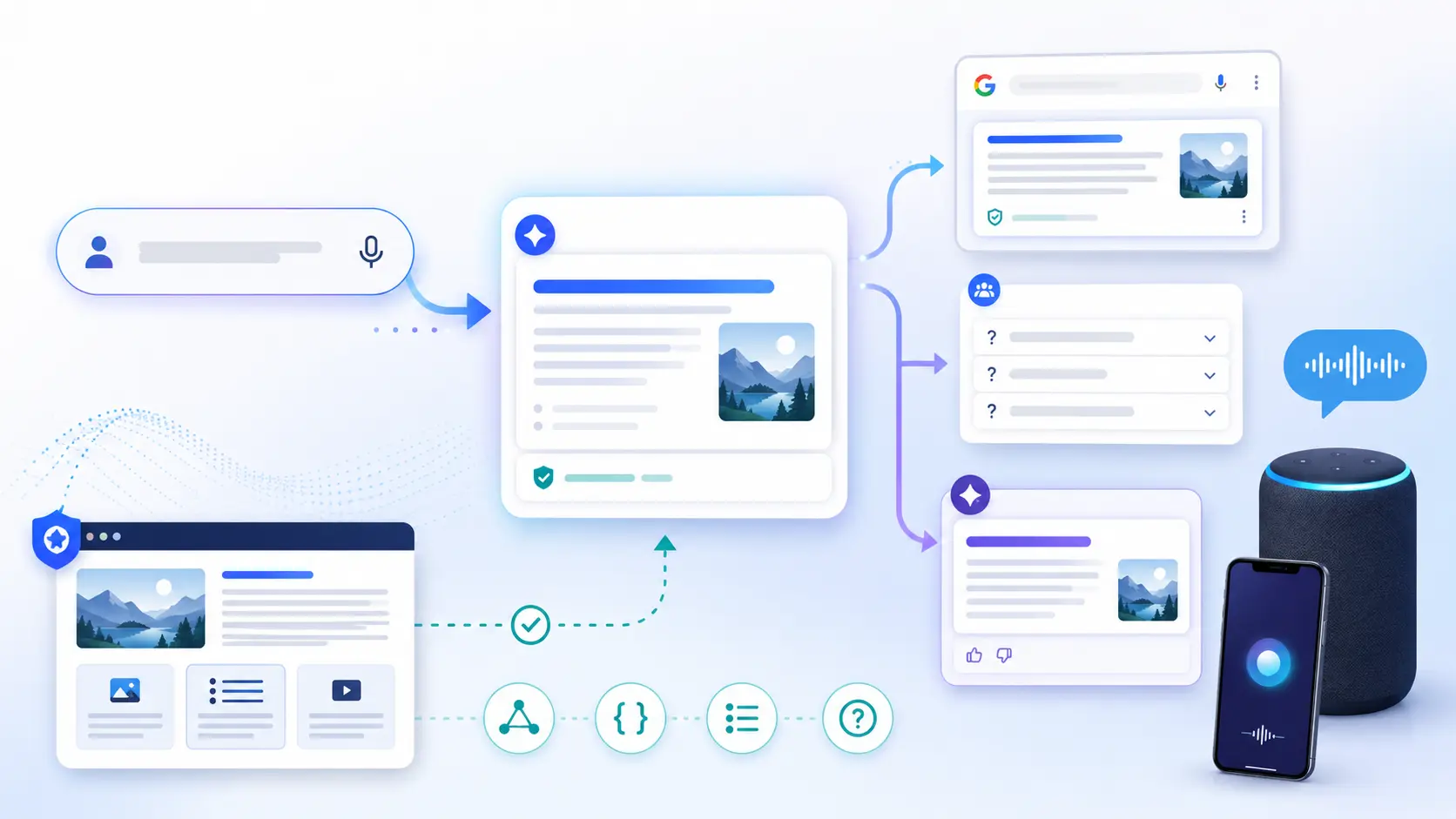
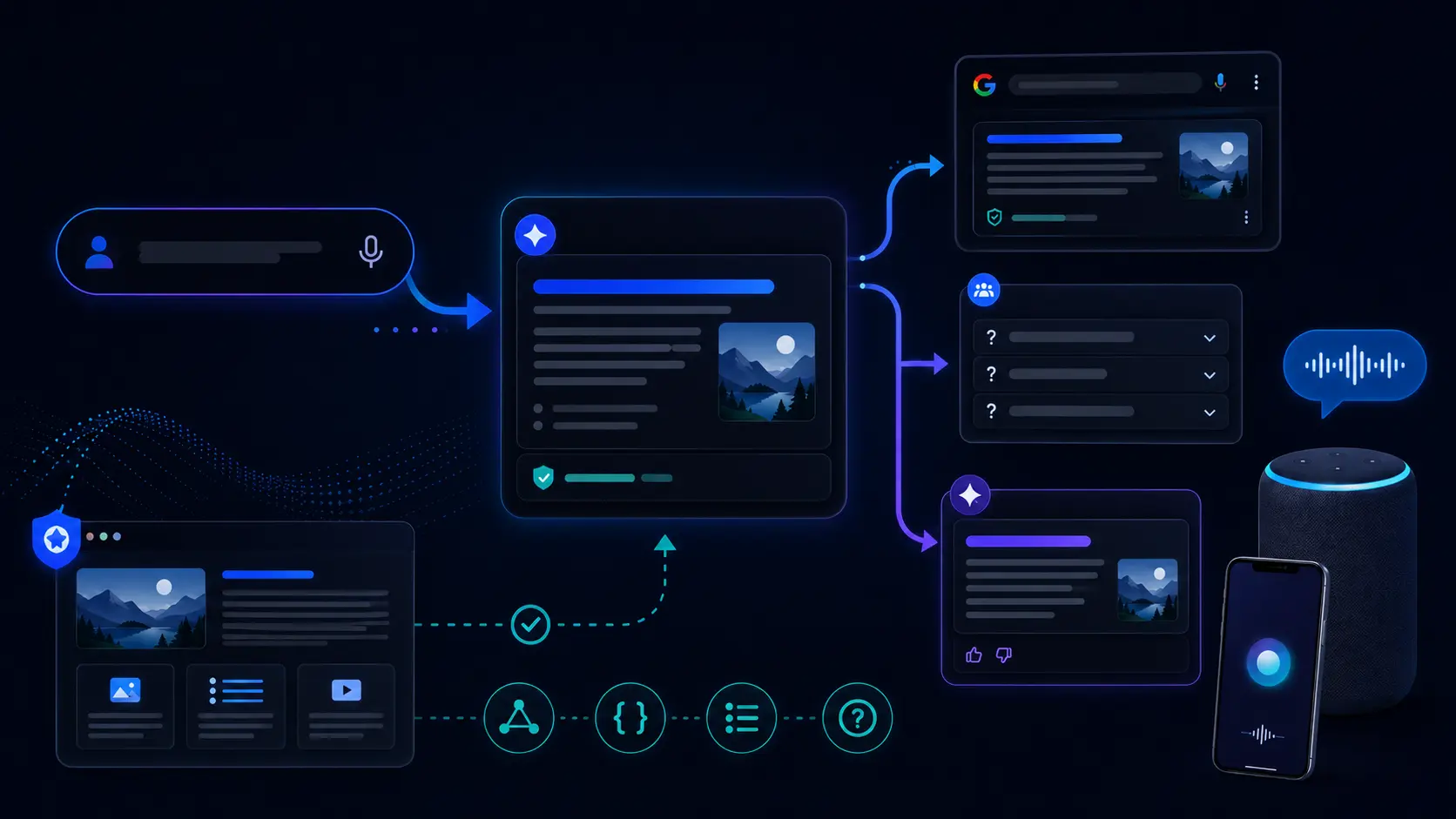
Ask Siri "what time is it in Tokyo?" or Google "how do you tie a tie?" and watch what happens. Increasingly, you do not get ten blue links. You get a single spoken sentence, a boxed featured snippet, or an AI Overview that answers the question outright. The click never happens, and only one source gets credited.
That is the world Answer Engine Optimization (AEO) is built for. AEO is the discipline of writing and structuring content so search engines, voice assistants, and AI tools select your page as the source for the answer they deliver. This guide covers what AEO is, how it compares with SEO and GEO, the tactics that actually move the needle, and how alt text fits into the picture.
Summary
Answer Engine Optimization (AEO) is the practice of structuring your content so that answer engines, including Google's featured snippets and AI Overviews, voice assistants like Siri and Alexa, and AI chatbots like ChatGPT and Perplexity, pick your page as the definitive cited answer. SEO competes for clicks on a ranked list. AEO competes for the single response the user actually sees or hears. With nearly 60% of Google searches now ending without a click (SparkToro), being the answer matters more than ranking on page one. The most effective tactics are leading with a direct answer in the first 40-60 words, structuring content with clear headings and lists, adding FAQ and HowTo schema, and including descriptive alt text on every meaningful image so multimodal answer engines understand your visual content.
What is Answer Engine Optimization?
Answer Engine Optimization (AEO) is the practice of optimizing your content so that answer engines, the systems that return a direct response rather than a list of links, choose your page as the source. Those systems include Google's featured snippets and AI Overviews, the "People also ask" panels, knowledge panels, voice assistants (Siri, Alexa, Google Assistant, Bixby), and AI search tools (ChatGPT, Perplexity, Gemini, Claude, Copilot).
AEO predates the current AI wave. The term entered the SEO vocabulary around 2014, when Google's introduction of featured snippets and the rapid growth of voice assistants forced marketers to think about a new question: not "how do we rank?" but "how do we become the answer that gets read aloud?" The principles that worked for featured snippets, lead with a direct response, structure content cleanly, mark it up with schema, are the same principles that now decide which sources get cited in AI-generated answers.
Put simply, SEO gets you onto the page. AEO turns your page into the answer. For image-heavy sites, descriptive alt text is part of how answer engines understand your content, because the modern crop of answer engines is multimodal and uses alt text to ground what the image shows.
Why AEO matters now
Search has been quietly shifting from "find me a page" to "give me the answer" for a decade. The shift is accelerating:
- Nearly 60% of Google searches end without a click as users get answers directly on the results page (SparkToro).
- Google AI Overviews appear in over half of US searches and reach roughly 1.5 billion monthly users (Search Engine Land).
- Roughly 27% of the global online population uses voice search on mobile, and the worldwide installed base of voice assistants has crossed 8 billion devices (Statista).
- "People also ask" boxes now appear in roughly half of all Google searches in the US (Ahrefs), each one a chance to capture an additional answer slot.
- ChatGPT has 800-900 million weekly active users, and Perplexity, Gemini, and Claude all surface citations alongside their answers (OpenAI).
Each of those formats has one thing in common: only one source gets quoted. If a competitor wins the snippet or the voice response for a query that matters to your business, the user never sees your link, even if you rank well organically. AEO is how you compete for that single slot.
SEO vs AEO vs GEO: how they differ
SEO, AEO, and GEO (Generative Engine Optimization) sound like alphabet soup, and they overlap heavily in practice. The cleanest way to think about them is as three layers of the same discovery stack, each targeting a different surface:
| SEO | AEO | GEO | |
|---|---|---|---|
| Primary goal | Drive organic clicks to your site | Become the cited answer in snippets and voice replies | Get cited inside AI-generated summaries |
| Main target | Traditional search results (Google, Bing) | Featured snippets, voice assistants (Siri, Alexa), PAA, knowledge panels | Generative AI tools (ChatGPT, Perplexity, Gemini) |
| Success metric | Rankings, CTR, organic traffic | Snippet wins, "zero-click" share, voice mentions | Citation share, AI referral traffic, brand mentions |
| Key tactics | Keywords, backlinks, long-form content, site authority | Direct answers, FAQ and HowTo schema, lists and tables, conversational phrasing | Expert quotes, statistics, citations, structured data |
| Query style | Short keyword phrases | Natural questions ("how do I", "what is") | Conversational, multi-part prompts |
| Traffic model | User clicks to your site | Often zero-click; brand still gets cited | AI may answer without the user ever visiting |
Are AEO and GEO the same thing?
No, but they are close cousins. AEO is the broader, older umbrella. It covers any system that returns a single direct answer, including featured snippets and voice assistants that have been around since the mid-2010s. GEO is the newer, narrower discipline focused specifically on getting cited inside generative AI responses. Both reward the same fundamentals: clear structure, direct answers, and trustworthy sourcing. Do them well and you tend to win on both surfaces.
Where AEO and SEO overlap
AEO does not replace SEO. The featured snippet almost always comes from a page that already ranks on Google's first page, often within the top three results. Strong SEO is what gets you eligible. AEO is what wins the snippet once you are eligible. The two strategies share more than they differ: both reward well-written, well-structured content with strong E-E-A-T signals.
How answer engines pick what to surface
Different answer surfaces select content in different ways, but the underlying mechanism is consistent: each one extracts a passage from a trusted source that directly responds to the query, and surfaces that single passage as the answer.
1. Featured snippets and "People also ask"
Google's algorithm scans high-ranking pages for passages that directly answer the query in 40-60 words, ideally just below a heading that matches the question. Pages with clean H2 questions followed by short, definitive answers are far more likely to be selected.
2. Voice assistants
Siri, Alexa, and Google Assistant typically read back a single sentence or two. They draw heavily from featured snippets and knowledge panels, and they reward content that sounds natural when spoken aloud. Long, formal sentences get truncated. Conversational answers win.
3. AI Overviews and generative answers
Google AI Overviews, ChatGPT search, and Perplexity use retrieval-augmented generation (RAG) to pull from multiple sources, then synthesize a single response with citations. Pages with clear factual statements, statistics, and structured data are more likely to be cited because they are easier for the model to extract cleanly.
Proven AEO strategies
The tactics below cluster into one rule: make it as easy as possible for an algorithm to lift a clean, self-contained answer off your page. Everything else is a variation on that theme.
1. Lead with a direct answer
The most important AEO move: put the answer in the first 40-60 words after each heading. The classic snippet-friendly pattern is a question as the heading followed by a one or two sentence definition. Save the nuance and the long form for the paragraphs below. Answer engines extract the most efficient response, so if your answer is buried 800 words in, you will lose to a competitor whose answer is in the first sentence.
2. Structure for extraction
- Question headings. Use the exact phrasing of common queries as H2/H3 headings ("What is AEO?", "How does voice search work?"). Search engines lean on heading-to-query matching.
- Lists and tables. "Best X" and "how to Y" queries overwhelmingly return bulleted snippets. Use ordered lists for steps and unordered lists for comparable items.
- Tables for comparisons. When the query implies a comparison ("X vs Y"), a clean HTML table is often what gets pulled into the snippet.
- Self-contained paragraphs. Each paragraph should make sense out of context, because that is exactly how it will appear in a snippet or AI Overview.
3. Write the way people ask
Voice and AI queries are longer and more conversational than typed keyword searches. Someone types "weather tomorrow" but says "hey Google, what's the weather going to be tomorrow?" Mirror that natural phrasing in your content. Use question-based headings, contractions, and second-person voice. If you can read your answer out loud and it sounds like something a human would say, you are halfway to winning the voice slot.
4. Add a dedicated FAQ section
FAQ blocks are the single highest-leverage AEO pattern. They map cleanly to "People also ask" boxes, they are perfect targets for FAQPage schema, and they give you a structured place to answer the long tail of secondary questions a single page should cover. Aim for five to ten genuine questions per major topic page, each with a 40-80 word answer.
5. Anchor everything in real sources
AI Overviews and answer engines disproportionately cite pages that cite their own sources. Statistics with named attributions, links to studies, and quotes from named experts make your content easier to trust and easier to verify. The Princeton GEO study found that adding expert quotations, statistics, and citations boosted AI visibility by 30-41%.
What does not work: keyword stuffing
Cramming variations of a keyword into every sentence used to be a viable SEO shortcut. It is actively harmful for AEO. Modern answer engines evaluate content holistically, and stuffed copy reads as low quality to both the algorithm and the user.
Schema markup for AEO
Structured data (JSON-LD schema) is the bridge between your content and the answer engine. It tells the algorithm exactly what your content represents, which makes it dramatically easier to extract a clean answer. The schema types that punch above their weight for AEO:
- FAQPage: the highest-impact schema for AEO. It signals that your page contains question-and-answer pairs that can be extracted directly into PAA boxes, voice replies, and AI Overviews.
- HowTo: step-by-step content. Use it for tutorials, recipes, and any "how do I" query. Each step becomes a self-contained candidate for extraction.
- QAPage: for pages built around a single user question (forum-style pages, support articles).
- Article / BlogPosting: establishes author, publication date, and topic. Critical for AI engines that weight freshness and authorship.
- Organization and Person: establishes entity identity. Helps voice assistants and AI Overviews answer "who is" and "what is X company" queries with your branded data.
- Product and Review: essential for ecommerce. Voice assistants now field a meaningful share of product queries.
One nuance: in 2023 Google restricted FAQ rich results in traditional search to only show on government and health-authority sites. Many SEO blogs took that to mean FAQ schema is dead. The opposite is true. FAQ markup is more valuable than ever for AEO because the signal moved from the visible snippet card to the invisible extraction layer that powers voice and AI answers. Keep your FAQ schema. Validate it with Schema.org validator or Google's Rich Results Test.
Voice search and AEO
Voice search is where AEO either wins or quietly disappears. There is no ranked list. There is one spoken answer. Optimizing for voice is a strict subset of optimizing for answer engines in general, with a few specific patterns that matter:
- Target conversational phrasing. Voice queries average three to five words longer than typed queries and are usually framed as full questions. Optimize for "what is the best WordPress alt text plugin?" not just "alt text plugin".
- Aim for an 8th-grade reading level. Voice assistants read your text aloud. Short sentences, simple words, and a friendly tone perform best.
- Use local schema where relevant. Roughly a quarter of voice queries are local ("near me"). LocalBusiness schema with full address, hours, and phone helps you win those.
- Mobile and speed matter. The majority of voice queries happen on mobile. Slow pages and poor Core Web Vitals scores cost you eligibility.
- Featured snippets are voice's quarry. Voice assistants pull heavily from snippet positions on Google. Win the snippet and you tend to win the voice reply too.
Why alt text matters for AEO
Answer engines have gone multimodal. Google AI Overviews, ChatGPT, Gemini, and Perplexity all process text and images together when deciding what to surface and what to cite. They still rely heavily on alt text to ground what each image represents, because text is what their indexing and retrieval layers can search and rank against. An image without alt text is, for AEO purposes, mostly invisible.
- Pages with strong multimedia descriptions are cited substantially more often by AI engines than text-only sources (Scribely).
- Multimodal AI models cross-reference alt text against the visible image to verify accuracy. Misaligned descriptions can trigger a relevancy penalty.
- Voice assistants describing image-driven results (recipes, product comparisons, how-to steps) read alt text aloud when no caption is available.
- For ecommerce, alt text carrying brand, product name, and key attributes is what surfaces a product image in a voice or AI shopping query.
What AEO-friendly alt text looks like
The same alt text that serves screen reader users well serves AEO well too. The underlying need is identical: a clear, natural description of what the image actually shows.
- Be specific and contextual. Describe the subject, the action, and any relevant attributes. Tie the description to the surrounding content.
- Use plain, conversational language. Voice assistants and AI summaries quote alt text verbatim. Write it the way you would describe the image to a friend.
- Preserve brand and product names. Names should appear identically across alt text, captions, and structured data. That consistency is what entity-level answers rely on.
- Do not stuff keywords. Keyword-jammed alt text reads as low quality to both algorithms and screen reader users, and modern answer engines actively downrank it.
Writing alt text at scale?
Alt Text Studio generates descriptive, contextual alt text for one image or a whole catalog, optimized for accessibility and for the answer engines that now read your images alongside your copy.
Common AEO mistakes
Burying the answer
A 300-word preamble before the answer kills snippet eligibility. Lead with the definition or instruction, then add context underneath.
Headings that do not match how people search
Clever "Diving deeper" or "Let's unpack this" headings do nothing for AEO. Use the question form people actually type or speak.
Skipping FAQ schema
Even after Google's 2023 rich-result restriction, FAQ schema remains the single most valuable signal for voice and AI answers. Keep it on every major topic page.
Writing for keywords, not questions
Voice and AI queries are full sentences. If your content reads like a keyword density essay, it will not match conversational queries.
Ignoring image content
Answer engines are multimodal. Images without alt text are invisible to them, and image-driven queries (recipes, products, comparisons) increasingly use multimedia in the answer.
Treating AEO as separate from SEO
Featured snippets and voice answers are almost always pulled from pages that already rank in the top three organic results. AEO without SEO is a brittle strategy.
Frequently asked questions
What is Answer Engine Optimization (AEO)?
AEO is the practice of structuring your content so answer engines pick your page as the source of the direct answer they deliver. Those answer engines include Google featured snippets and AI Overviews, "People also ask" panels, voice assistants like Siri and Alexa, and AI tools like ChatGPT and Perplexity. Unlike SEO, which aims to rank in a list of results, AEO competes for the single response the user actually sees or hears.
Is AEO different from SEO?
Yes, but they overlap heavily. SEO is about ranking. AEO is about being the single extracted answer once you rank. Featured snippets are almost always pulled from pages that already sit in the top three organic results, so strong SEO is the foundation that makes AEO possible.
Is AEO the same as GEO?
Closely related, not identical. AEO is the broader, older discipline covering any "answer engine," including featured snippets and voice assistants. GEO is the narrower, newer practice of getting cited inside generative AI responses from ChatGPT, Perplexity, Gemini, and similar tools. Both reward direct answers, clean structure, and trustworthy sourcing.
What schema types help AEO the most?
FAQPage is the highest-impact schema for AEO, followed by HowTo for step-by-step content, QAPage for question-driven pages, and Article or BlogPosting for editorial content. Organization and Person schema help voice assistants and AI Overviews answer entity-level queries about your brand.
How does alt text help AEO?
Answer engines are multimodal and rely on alt text to understand what each image represents. Images without descriptive alt text are effectively invisible to voice assistants and AI engines. Descriptive alt text on product, recipe, and how-to images is what surfaces those images in voice and AI answers.
How do I measure AEO success?
Track featured snippet ownership for your target queries, monitor "People also ask" appearances, watch zero-click share for branded queries, and review AI referral traffic from ChatGPT, Perplexity, and similar tools in your analytics. Traditional keyword rankings alone do not capture AEO performance.
Start optimizing for answer engines today
The blue-link era is not over, but it is shrinking. Featured snippets, voice replies, and AI Overviews are eating an ever-larger share of search attention, and only one source gets credited for each answer. The sites that adapt early, by leading with direct answers, structuring content for extraction, and marking up everything with the right schema, are the ones that get cited.
Alt Text Studio takes care of the multimedia piece. Generate accurate, contextual alt text for every image in your library so the multimodal answer engines that now read your images alongside your copy can actually see what you publish.